



Price: $1,997.99 $1,328.09
(as of 2026-10-24 03:35 GMT+0000 – Details)

Quantum Mini LED Full‑Array Backlight
The Quantum Mini LED full‑array backlight uses thousands of precisely controlled lighting zones to shape brightness on a per‑scene basis. In dark sequences the zones dim independently, revealing subtle shadow detail that many conventional LED panels lose, while bright highlights can reach high peak luminance without blooming. This local‑dimming approach improves contrast depth and makes high‑dynamic‑range material appear more three‑dimensional. Because the Mini LEDs are much smaller than traditional LEDs, the transition between zones is smoother, reducing visible halo artifacts around bright objects on dark backgrounds. The result is a more immersive viewing experience for movies and high‑contrast TV shows.
NQ4 AI Gen2 Processor
The NQ4 AI Gen2 processor acts as the central intelligence for picture and sound optimization. It analyses each frame in real time, applying machine‑learning models that sharpen edges, reduce noise, and enhance color fidelity without introducing artificial artifacts. Motion handling benefits from the processor’s ability to interpolate frames, delivering smoother playback for fast‑moving sports or action sequences. On the audio side, the same engine drives advanced sound processing that virtualizes a wider soundstage and clarifies dialogue. Because the processing is AI‑based, the degree of improvement can vary with source quality; heavily compressed streams may show less noticeable gain than pristine 4K sources.
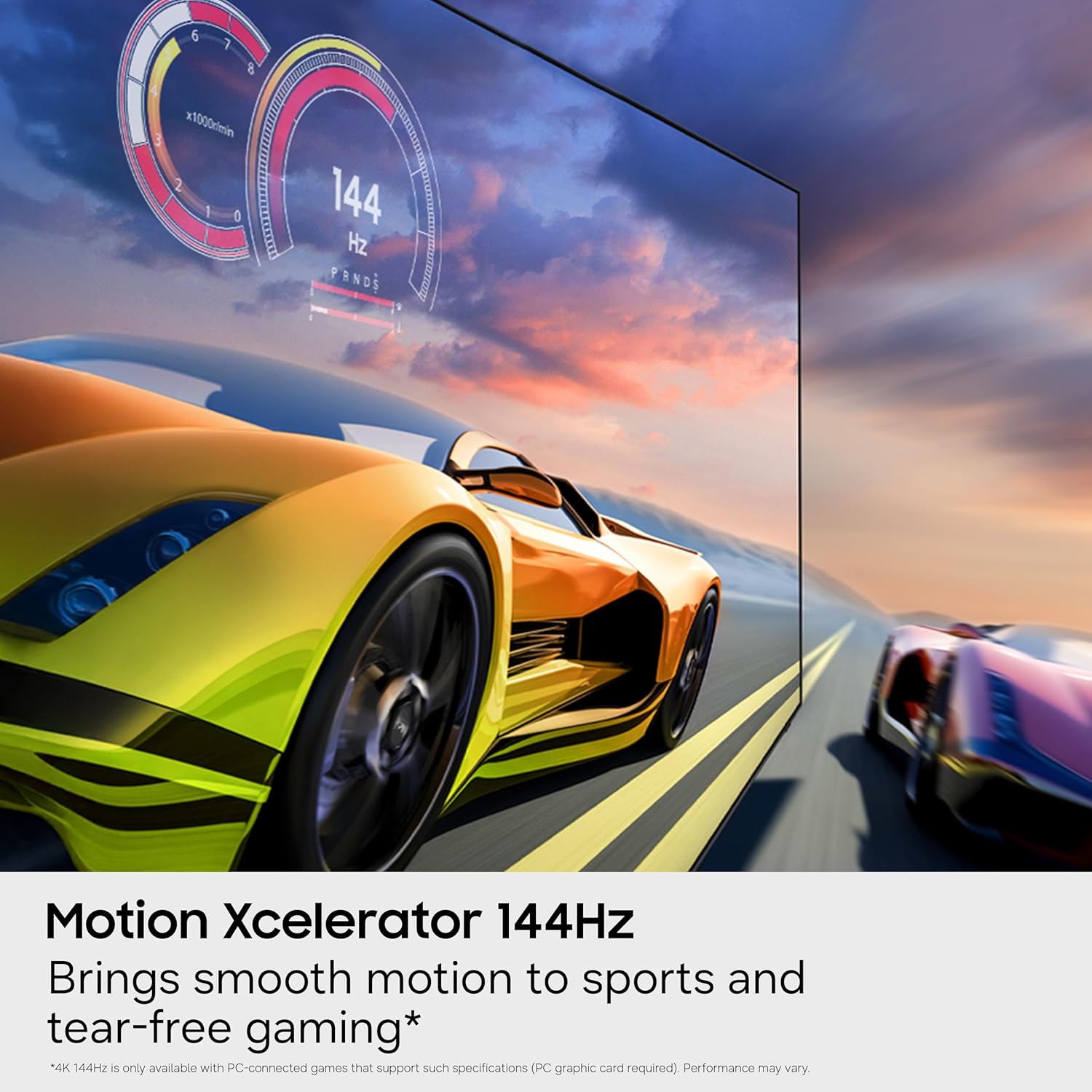
Motion Xcelerator 144Hz
Motion Xcelerator 144Hz provides a native 144 Hz refresh rate that is especially valuable for gaming and high‑frame‑rate sports broadcasts. The panel supports variable refresh rate (VRR), allowing the display to synchronize its refresh cycle with the output of a compatible graphics card or console, which eliminates stutter and screen tearing during rapid motion. However, the 144 Hz mode is only reachable when the TV receives a 4K @ 144 Hz signal from a PC equipped with a capable GPU; standard console outputs typically max out at 120 Hz. Users without a suitable PC will see the panel fall back to its default 120 Hz or 60 Hz operation, so the advertised peak refresh rate is conditional.
4K AI Upscaling
The 4K AI upscaling engine takes lower‑resolution inputs—such as 1080p streaming, 720p broadcast, or older DVD content—and reconstructs them to a 3840 × 2160 pixel grid using trained neural networks. The algorithm predicts missing detail by referencing patterns learned from a large image database, sharpening edges and restoring texture while suppressing upscaling artifacts like ringing or excessive smoothing. The manufacturer notes that the final picture quality depends on the source material; heavily compressed or noisy feeds may not upscale to the same level as clean, high‑bitrate streams. Consequently, viewers should expect a noticeable improvement for typical streaming services but not a true native‑4K replacement.
Auto HDR Remastering
Auto HDR Remastering analyses standard dynamic range (SDR) content frame by frame and expands its luminance range to emulate high dynamic range characteristics. The process lifts highlight brightness, deepens shadow detail, and widens the color gamut, producing a more vivid image without requiring native HDR metadata. Because the conversion is algorithmic, the result can sometimes appear overly aggressive on content that was originally graded for SDR, leading to blown‑out highlights or unnatural color saturation. The TV offers a toggle to disable the feature, allowing purists to retain the creator’s intended look when the automatic enhancement feels excessive.
Quantum Dot Color and Overall Picture Performance
Quantum Dot technology supplies a wide, stable color palette that remains saturated even at the high brightness levels delivered by the Mini LED array. The nanocrystal layer converts blue backlight into highly pure red and green primaries, enabling the display to cover a large portion of the DCI‑P3 color space. When combined with the full‑array local dimming, bright scenes retain color volume instead of washing out, and dark scenes keep hue accuracy because the backlight can be dimmed without sacrificing chromaticity. This synergy means that HDR content, which demands both high luminance and deep color, is reproduced with greater fidelity than on conventional LED panels lacking quantum‑dot enhancement.
Practical Considerations and Limitations
In practice, the TV’s feature set is most fully realized when paired with a modern PC capable of 4K @ 144 Hz output and a graphics card that supports VRR, because only then does the Motion Xcelerator reach its advertised refresh rate. The AI‑driven upscaling and HDR remastering rely on the NQ4 processor’s inference engine, so performance scales with the complexity of the source; heavily compressed streams may show limited gains. Additionally, the Mini LED backlight, while precise, still exhibits a faint blooming halo around extremely bright specular highlights in very dark rooms, a characteristic of current Mini LED implementations. Users should also verify that their streaming apps deliver high‑bitrate 4K feeds to benefit from the upscaling pipeline, and consider disabling Auto HDR Remastering for content mastered in SDR if the automatic expansion appears unnatural.