
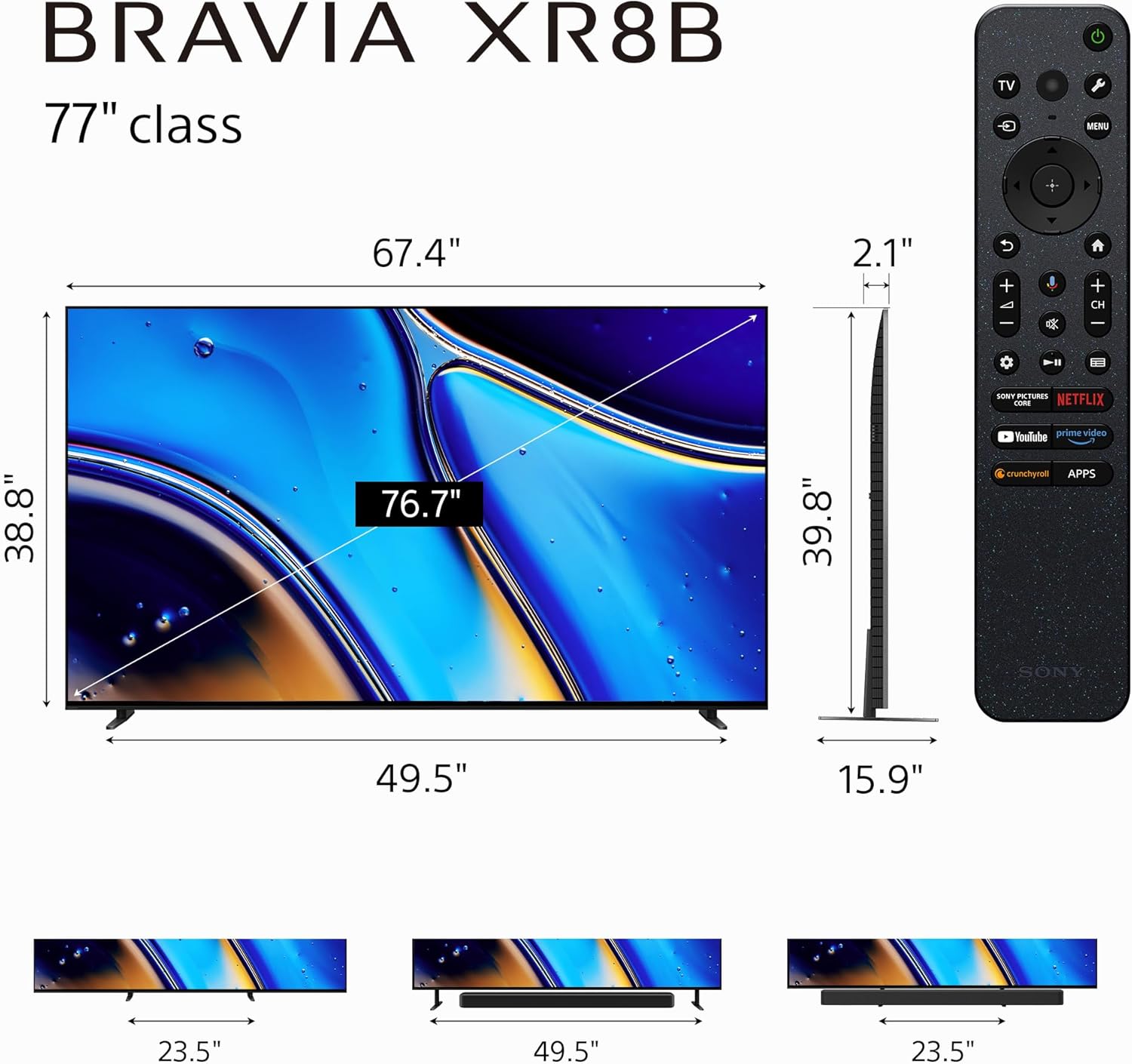


Price: $2,498.00
(as of 2026-10-24 03:50 GMT+0000 – Details)

Pure Black OLED Contrast
The panel uses over eight million self‑lit pixels that can be turned off individually, delivering true black levels alongside high peak brightness. In practice this means dark scenes retain detail without the gray‑wash common to backlit LCDs, and bright highlights appear more vivid because they are not limited by a global backlight. The benefit is most noticeable in content mastered for HDR, where the contrast ratio can be fully exploited. However, the perceived advantage depends on ambient lighting; in very bright rooms the absolute black level may be less discernible, and the panel’s organic materials can experience gradual luminance decay over many thousands of hours.
XR Processor Real‑Time Enhancement
The XR Processor analyses each frame on the fly, adjusting color volume, contrast curves, and sharpness to match the scene’s intent. This dynamic processing can improve lower‑quality sources by reducing banding and enhancing texture, while preserving the director’s color grading for premium streams. The algorithm works across all inputs, so broadcast TV, streaming apps, and external devices all receive the same treatment. A practical limitation is that aggressive processing may introduce subtle artifacts on very fast motion if the source already contains compression artifacts, and the processor cannot create detail that was never captured.
Google TV Platform and Voice Control
Google TV aggregates apps such as Netflix, Prime Video, Disney+, YouTube, Apple TV, Crunchyroll and many others into a single home screen, eliminating the need to switch between separate app launchers. The integrated Google Assistant allows voice search for titles, actors, or genres, and can control playback, volume, and smart‑home devices. This unification simplifies discovery, especially for households with multiple streaming subscriptions. The experience relies on a stable internet connection; voice commands may misinterpret accents or background noise, and the interface can feel cluttered if many apps are installed, requiring occasional manual organization.
Wireless Casting with AirPlay 2 and Google Cast
Support for Apple AirPlay 2 and Google Cast lets users mirror or stream content from iOS, macOS, Android, and Chrome devices without additional hardware. This is convenient for sharing photos, presentations, or video from apps that lack a native TV version. Casting performance depends on the local Wi‑Fi bandwidth and router quality; high‑bitrate 4K HDR streams may stutter on congested networks. Additionally, DRM‑protected content from some services may block casting, limiting the feature to freely licensed or personally owned media.
Studio‑Calibrated Picture Modes for Major Services
Dedicated picture presets for Netflix and Prime Video are calibrated to the studios’ mastering specifications, aiming to reproduce the exact color space, gamma, and white point intended by creators. When these modes are selected, the TV disables most post‑processing, delivering a more faithful image for supported titles. The advantage is most evident on original productions that adhere to the calibration standards; for third‑party or older catalog content the mode may not improve perceived quality and could even look dimmer if the source mastering differs.
PlayStation 5 Optimized Gaming Features
Auto HDR Tone Mapping and Auto Genre Picture Mode automatically adjust HDR brightness and picture settings when a PS5 signals a game or streaming app. This reduces the need for manual calibration and ensures that HDR highlights are rendered within the panel’s capabilities. The TV also offers low input lag and supports 4K @ 120 Hz via HDMI 2.1, beneficial for competitive gaming. Limitations include the requirement that the game itself implements the relevant HDMI 2.1 features; titles limited to 60 Hz or lacking HDR metadata will not trigger the automatic enhancements.
Cinematic Audio with Dolby Vision, Atmos, IMAX Enhanced, and DTS:X
The set supports Dolby Vision HDR and Dolby Atmos object‑based audio, IMAX Enhanced certification, and DTS:X decoding, providing a theater‑like experience when compatible content is played. The sound‑from‑screen technology uses actuators behind the OLED panel to emit audio directly from the picture, aligning sound cues with on‑screen action. This creates a more immersive soundstage than traditional down‑firing speakers. However, the built‑in system cannot match the dynamic range or bass impact of a dedicated external soundbar or AV receiver, and Atmos height effects are simulated rather than delivered via discrete overhead speakers.
Upscaling and Motion Clarity
XR Clear Image up‑scales HD and standard‑definition sources toward 4K resolution by reconstructing missing detail using machine‑learning models trained on high‑resolution content. XR OLED Motion inserts intermediate frames and controls pixel response to reduce blur during fast sports or action sequences. Together they improve the perceived sharpness of legacy broadcasts and streaming libraries that are not native 4K. The up‑scaling quality varies with source compression; heavily compressed streams may still show artifacts, and motion interpolation can introduce the “soap‑opera effect” on cinematic material, which some viewers may prefer to disable.