



Price: $5,525.72
(as of 2026-10-24 05:18 GMT+0000 – Details)

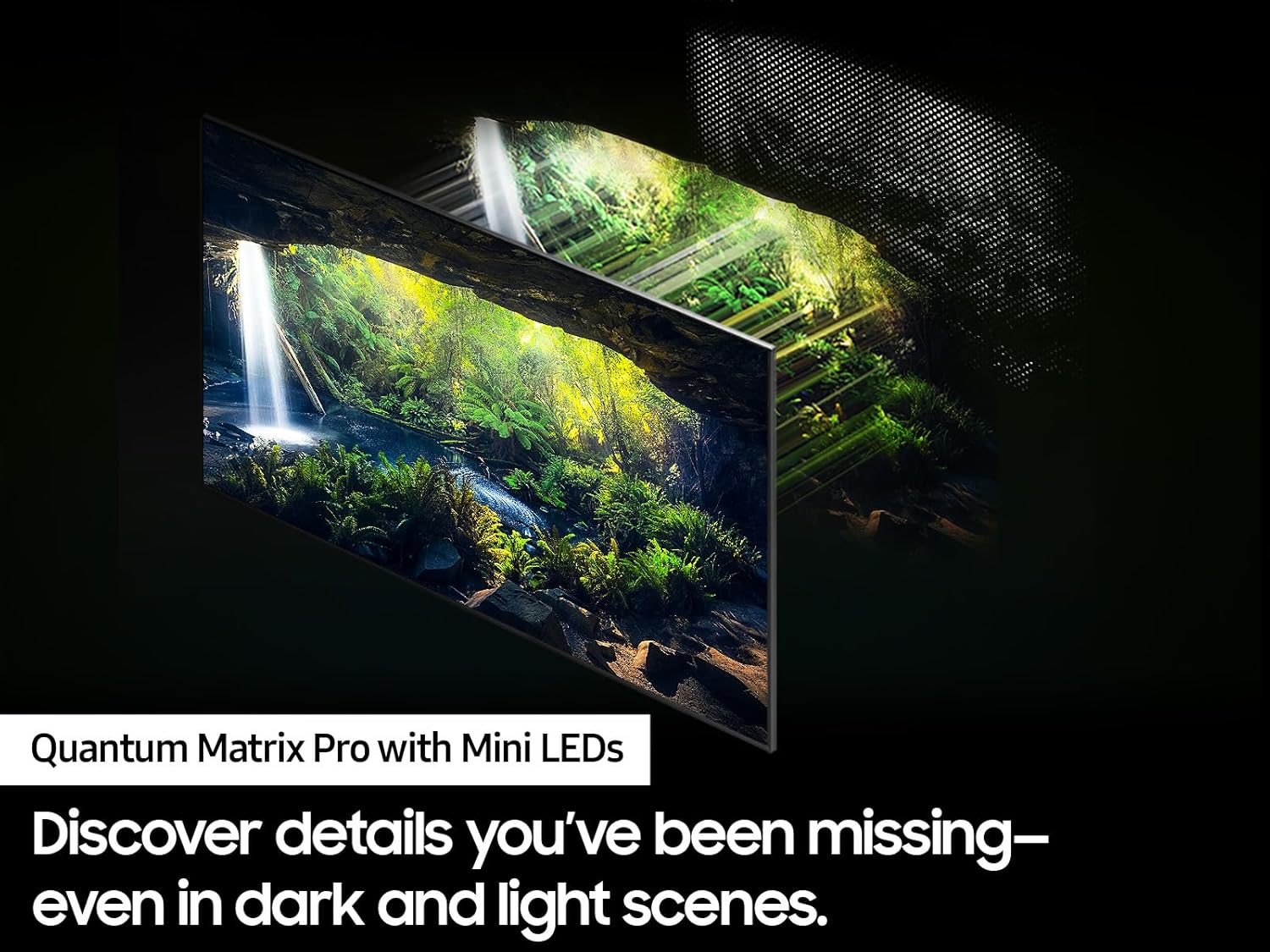
Quantum Matrix Pro with Mini LEDs
The Quantum Matrix Pro backlight uses mini‑LED elements that are 1.5 times more numerous than the zones in the standard Quantum Matrix implementation. This increase allows finer local dimming, so bright highlights can coexist with deep shadows without the halo artifacts that appear when a single large zone covers both. In practice the TV can reveal detail in very dark scenes and preserve specular highlights in bright scenes, which benefits HDR content and high‑contrast gaming. The limitation is that the number of zones, while higher than before, is still finite; extreme contrast transitions may show slight blooming compared with self‑emissive technologies.
Neo Quantum HDR 8K+ Color and Contrast
Neo Quantum HDR 8K+ expands the dynamic range by delivering deeper blacks, brighter peaks, and a wider color volume than the previous generation. The panel’s 8K pixel count (7 680 × 4 320) provides the spatial resolution needed to render the extra color nuance, and the HDR metadata mapping attempts to preserve the creator’s intent across the full luminance range. The practical benefit is most visible with native 8K HDR streams or discs; with lower‑resolution sources the TV must rely on upscaling and tone‑mapping, which can only approximate the full HDR experience.
Real 8K Resolution with AI Upscaling
The set advertises “Real 8K Resolution” powered by 512 AI neural networks that analyze each frame and reconstruct missing detail to produce a 4× increase over 4K. This upscaling works on any incoming signal—broadcast, streaming, or gaming—and can sharpen textures, edges, and fine patterns. However, the quality of the result is bounded by the source material; heavily compressed or low‑bitrate video will still exhibit artifacts that the AI cannot fully eliminate, and the upscaling process may introduce subtle ringing on very high‑frequency content.
AI Motion Enhancer for Fluid Motion
AI Motion Enhancer interpolates frames and sharpens moving objects to reduce judder and blur, which is especially noticeable in fast‑paced sports, action movies, and competitive gaming. The algorithm also targets small moving elements such as subtitles, keeping them legible during rapid camera pans. While the feature improves perceived smoothness, aggressive interpolation can create the “soap‑opera effect” on cinematic 24 fps material, and some viewers may prefer to disable it for a more film‑like cadence.
Dolby Atmos and Object Tracking Sound+
Built‑in Dolby Atmos decoding works together with Object Tracking Sound+ to steer audio cues across the TV’s speaker array so that sounds follow on‑screen motion—e.g., a car racing left‑to‑right is heard moving across the front soundstage. This creates a more immersive 3‑D audio field without external speakers. The physical constraints of a flat‑panel chassis limit low‑frequency extension and maximum SPL, so bass‑heavy scenes may lack impact compared with a dedicated soundbar or home‑theater system.
Real Depth Enhancer Pro for Dimensional Imaging
Real Depth Enhancer Pro identifies the focal point of each frame and locally adjusts contrast and sharpness to mimic the way human vision perceives depth. The result is a subtle sense of layering that can make foreground subjects pop against backgrounds, enhancing realism in nature documentaries and cinematic shots. The effect is algorithmic rather than stereoscopic, so it does not require glasses, but its visibility varies with content type and viewing distance; on very large screens the depth cue may be more pronounced.
NQ8 AI Gen2 Processor, Motion Xcelerator 165 Hz, and Smart Platform
The NQ8 AI Gen2 processor coordinates upscaling, HDR remastering, audio enhancement, and overall system responsiveness. Auto HDR Remastering applies AI‑based tone mapping to SDR sources, lifting highlights and expanding contrast for a more HDR‑like appearance. Motion Xcelerator 165 Hz delivers ultra‑smooth 4K motion at up to 165 frames per second, but this mode is limited to 4K resolution and requires a compatible PC connection; it is not available for native 8K signals. The TV runs Samsung Tizen OS, providing direct access to major streaming apps and voice control via built‑in assistants (Alexa, Bixby, Google Assistant). A Samsung account is required for network‑based smart services; without signing in only external HDMI sources and over‑the‑air broadcasts (where a tuner exists) remain functional.