



Price: $649.99
(as of 2026-10-24 04:44 GMT+0000 – Details)

Mini‑LED Backlighting and Contrast
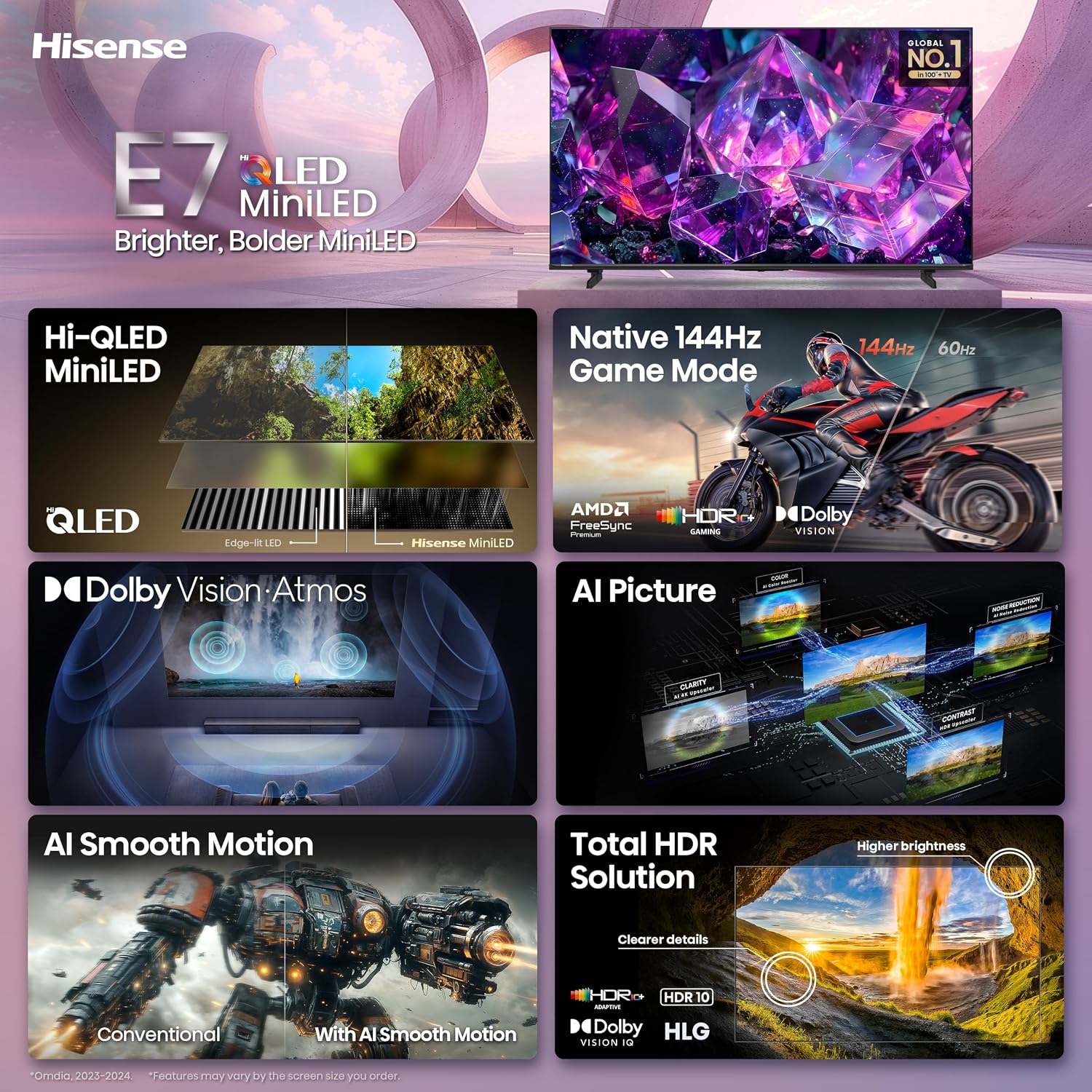
Mini‑LED backlighting divides the screen into thousands of local dimming zones, allowing the TV to raise brightness in bright areas while keeping dark regions deep. This zone‑level control improves perceived contrast compared with conventional edge‑lit panels, so shadows in night scenes retain detail and highlights in daylight content stay vivid. The practical result is a more balanced picture across varied lighting conditions, though the absolute peak brightness still depends on the panel’s maximum output and the number of zones implemented.
Native 144 Hz Refresh Rate
The native 144 Hz refresh rate is presented as a hardware capability rather than an interpolated mode, meaning the panel can display up to 144 distinct frames each second. For gaming, this reduces motion blur and input latency, giving competitive players a clearer view of fast‑moving objects. In broadcast sports the higher frame cadence makes rapid camera pans smoother, but the benefit only materializes when the source material or console outputs at 120 Hz or 144 Hz; standard 60 Hz streams will not gain extra frames.
Comprehensive HDR and Audio Support
Dolby Vision IQ and Dolby Atmos are supported together with HDR10+, HDR10 and HLG, giving the set a full HDR stack. Dolby Vision IQ adds scene‑by‑scene metadata that adapts the picture to ambient light, while Dolby Atmos provides object‑based audio that can be rendered through the TV’s built‑in speakers or passed to an external sound system. The combination aims to preserve the creator’s intent for both brightness and spatial sound, though the actual immersive effect depends on speaker placement and room acoustics. Because the TV includes multiple HDR formats, streaming services that deliver Dolby Vision or HDR10+ will automatically select the best match, reducing the need for manual switching. However, the peak luminance achievable by the Mini‑LED array may limit the full dynamic range of Dolby Vision content in very bright rooms, and the internal speakers, while Atmos‑compatible, cannot reproduce the height channels that a dedicated speaker layout provides.
AI Picture Processing and Ambient Light Adaptation
AI Picture processing analyses each frame in real time, adjusting brightness, contrast, colour saturation and sharpness according to the detected content type. The AI Light Sensor complements this by measuring ambient illumination and scaling the backlight output so that the image remains comfortable in a dark living room or a sun‑lit kitchen. Together they aim to eliminate the need for manual picture presets, but the algorithms rely on the quality of the source signal; heavily compressed streams may limit the effectiveness of scene‑by‑scene optimisation.
Motion Handling, MEMC and Sports Mode
Motion handling combines MEMC (Motion Estimation, Motion Compensation) with an AI‑driven Smooth Motion engine and a dedicated Sports Mode. MEMC inserts interpolated frames to raise the apparent frame rate, which can make fast action appear smoother, while the AI layer attempts to reduce artefacts such as haloing or judder. When the TV detects sports content it automatically raises motion interpolation strength and boosts crowd‑related audio frequencies. The trade‑off is that aggressive interpolation may introduce the “soap‑opera effect” on cinematic material, so users who prefer a film‑like look may need to disable or lower the setting.
Filmmaker Mode and AI 4K Upscaling
Filmmaker Mode disables all post‑processing — including motion smoothing, sharpening and dynamic contrast — and forces the display to respect the original aspect ratio, colour space and frame rate of the source. This provides a reference‑grade view for movies mastered in 24 fps, but it also means the TV will not apply its AI enhancements, so viewers accustomed to the brighter, sharper default picture may find the image dimmer. The AI 4K Upscaler uses deep‑learning models to reconstruct detail in sub‑4K sources, reducing noise and sharpening edges; its effectiveness varies with the quality of the original encode.
Smart Platform, Connectivity and Overall Positioning
The set runs the Fire TV operating system with integrated Alexa+ voice control, offering direct access to major streaming apps, live TV guides and smart‑home routines. Because the platform is cloud‑connected, software updates can add new HDR formats or refine AI algorithms over time. Connectivity includes HDMI 2.1 ports that support 4K @ 144 Hz, VRR and ALLM, enabling full use of the native refresh rate with modern consoles. The overall package targets buyers who want a single device for movies, sports and gaming without external boxes, though the built‑in audio remains limited compared with a dedicated soundbar.