




Price: $748.99 $549.99
(as of 2026-10-24 01:17 GMT+0000 – Details)

Mini‑LED Backlight and Full‑Array Local Dimming
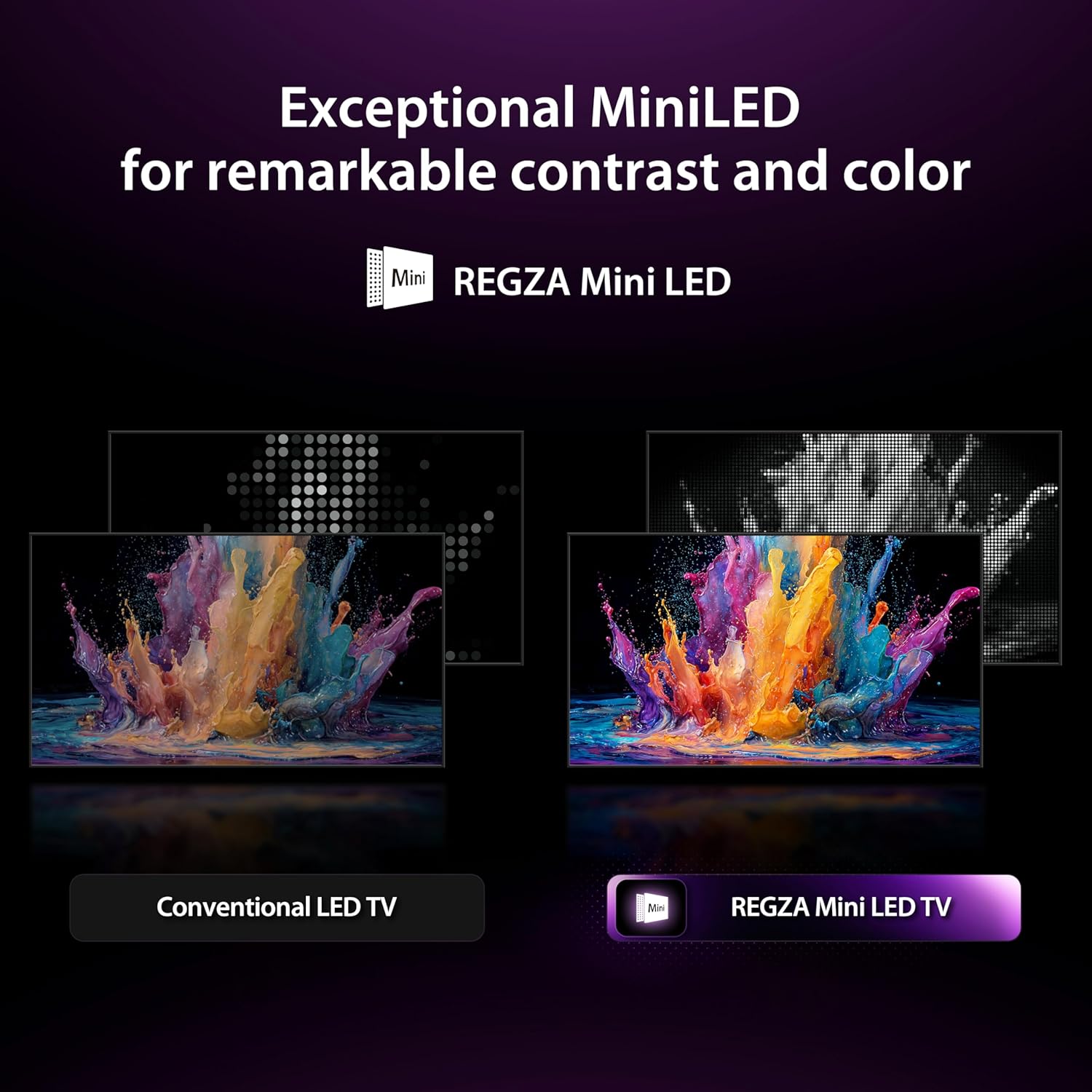
The Z670R series uses precision‑controlled Mini LEDs arranged in a full‑array layout, allowing each zone to be dimmed or brightened independently. This architecture produces deeper blacks and brighter highlights than conventional edge‑lit panels, which improves contrast in dark scenes and preserves detail in bright areas. Because the dimming zones are distributed across the entire screen, the TV can render high‑dynamic‑range content with more accurate luminance transitions, reducing the halo effect that sometimes appears around bright objects on a dark background. The practical benefit is a more lifelike 4K picture whether the source is a movie, a sports broadcast, or a video game, though the exact number of dimming zones is not disclosed, so the granularity of local dimming cannot be quantified from the provided information.
REGZA Engine ZRi Gen3 AI Processing
At the heart of the picture and sound pipeline sits the REGZA Engine ZRi Gen3, an AI‑driven processor tuned by Toshiba engineers in Japan. The engine analyses each frame in real time, adjusting clarity, contrast, and color balance on a scene‑by‑scene basis. It also applies similar intelligence to the audio path, shaping frequency response to match the visual content. This dual‑domain optimization aims to deliver a more natural viewing experience without manual calibration. The description emphasizes “fine‑tuned” processing but does not specify the neural‑network topology or the latency introduced, so the exact impact on fast‑motion handling remains an inference rather than a measured figure.
REGZA Power Audio Pro with Integrated Bass Woofer
Audio reproduction is handled by REGZA Power Audio Pro, which pairs a dedicated bass woofer with dual clear‑direct speakers and tuned amplifiers. The woofer is designed to generate deep, resonant low frequencies that can physically shake the room, while the direct speakers focus on vocal clarity and mid‑range detail. This configuration seeks to eliminate the need for an external soundbar for many living‑room setups. However, the specification does not provide total wattage, driver sizes, or supported audio codecs beyond Dolby Atmos, so the maximum output level and low‑frequency extension cannot be verified from the supplied data.
Fire TV Platform and Alexa Voice Control
The smart experience runs on Amazon’s Fire TV OS, which aggregates live channels, streaming apps, and a unified Channel Guide on the home screen. Navigation can be performed with the included remote or by pressing the microphone button and speaking to Alexa. Voice commands extend beyond content search to include sports scores, timers, reminders, and smart‑home control. This integration reduces the number of separate devices required for a connected living room. The description does not mention the Fire TV version, app store completeness, or any regional limitations, so the exact feature parity with other Fire TV devices remains unspecified.
Gaming‑Focused Features: Native 144 Hz, VRR, ALLM, FreeSync Premium
For competitive gaming the panel offers a native 144 Hz refresh rate, complemented by Game Mode Pro, AMD FreeSync Premium, variable refresh rate (VRR) up to 144 Hz, and auto low‑latency mode (ALLM). These technologies work together to minimize motion blur, eliminate screen tearing, and automatically switch the TV into its lowest‑latency picture mode when a compatible console or PC is detected. The combination targets next‑generation consoles and high‑performance PCs, promising responsive, tear‑free gameplay. The spec sheet does not list input‑lag measurements, HDMI 2.1 bandwidth per port, or support for 4K @ 144 Hz with full chroma subsampling, so those performance details remain unknown.
QLED Color Volume and Total HDR Solution Pro
Color reproduction leverages Toshiba’s QLED technology, claiming over a billion shades that stay realistic across the luminance range. The Total HDR Solution Pro adds support for Dolby Vision IQ, HDR10+, HDR10+ Adaptive, HLG, and other HDR formats, enabling brighter highlights, richer contrast, and enhanced detail regardless of the source. Dolby Vision IQ further adapts the picture to ambient lighting using the TV’s built‑in sensor. While the marketing language emphasizes “vivid, lifelike colors,” the absence of measured color‑gamut percentages (e.g., DCI‑P3 coverage) or peak brightness figures prevents a quantitative assessment of HDR performance.
Design, Ambient Light Sensing, and Practical Considerations
The chassis follows a minimalist Japanese aesthetic with clean lines intended to blend into modern interiors. An AI Light Sensor Pro continuously measures room illumination and adjusts both brightness and color temperature to reduce eye strain during extended viewing sessions. This automatic calibration can be convenient for users who prefer not to manually tweak settings. Potential limitations include the lack of disclosed sensor accuracy, the possibility of aggressive dimming in very bright rooms, and the absence of information on bezel width, stand adjustability, or VESA mount compatibility. Buyers should verify these physical attributes against their installation requirements before purchase.