



Price: $169.99 $157.97
(as of 2026-10-24 03:57 GMT+0000 – Details)

Unified Smart Experience
The Hisense 40‑inch QD4 Series combines a Full HD 1080p panel with the VIDAA smart platform, which aggregates streaming apps, live TV channels and free content into a single interface. The operating system uses AI‑driven personalization to surface recommendations without noticeable loading delays, and it supports voice commands in 28 languages while keeping voice data on‑device. This unified approach reduces the need to switch between multiple remotes or apps, making everyday navigation faster for households that rely on a variety of services.
Hi‑QLED Color Performance
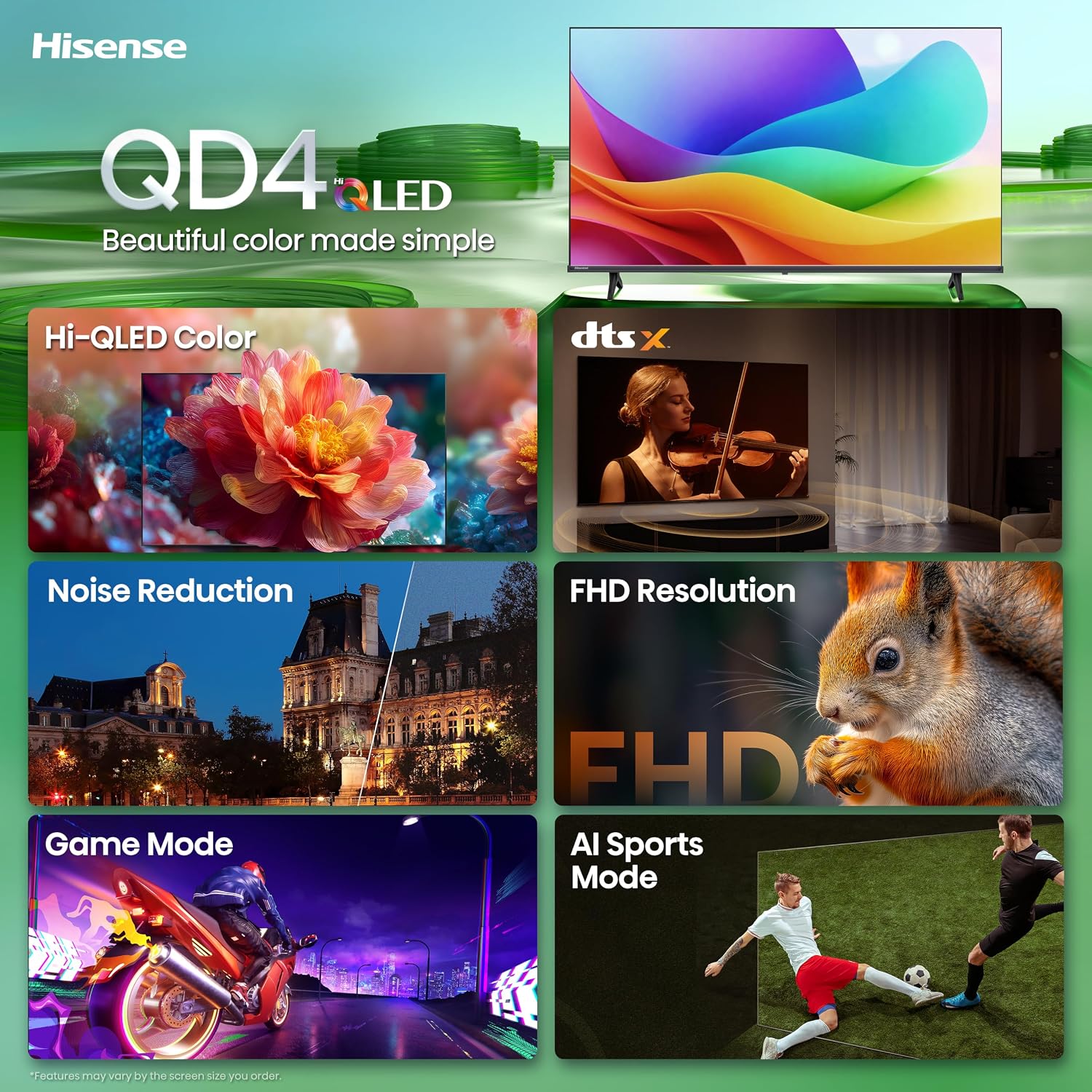
Hi‑QLED technology is marketed as delivering true‑to‑life shades, scenes and skin tones, aiming to render each frame as the creator intended. By enhancing the color gamut beyond a standard LCD backlight, the set can produce more saturated reds, greens and blues, which benefits movies, nature documentaries and sports broadcasts. The practical impact is most visible in high‑contrast scenes where subtle hue shifts become noticeable; however, the underlying panel remains a 1080p resolution, so the color advantage does not translate into higher pixel density.
Full HD Resolution with Full‑Array Backlight
The display uses a 1080p High‑Definition LCD paired with a Full Array LED backlight, which distributes illumination evenly across the screen. This arrangement improves brightness uniformity and reduces clouding compared with edge‑lit designs, resulting in a sharper, brighter picture for everyday viewing. The limitation is that the native resolution caps detail at 1920 × 1080, so 4K source material will be down‑scaled, and fine textures in high‑resolution content may appear softer than on a native 4K panel.
Noise Reduction for Cleaner Images
Hisense’s Noise Reduction scans each frame and filters grainy artifacts, targeting both high‑speed action and low‑light scenes. In practice this can make compressed streaming video or older broadcast material look smoother, preserving edge definition without introducing excessive smoothing that would blur fine detail. The feature is automatic, so users do not need to adjust settings, but aggressive noise filtering can occasionally soften intentional film grain or texture in cinematic content.
Immersive Audio with DTS Virtual:X
DTS Virtual:X creates a virtual surround field that places audio cues around and above the listener, aiming for a room‑filling experience without additional speakers. For movies and games this adds a sense of depth, making dialogue clearer and effects more directional. The technology relies on psychoacoustic processing rather than physical height channels, so the effect varies with room acoustics and seating position; it cannot fully replicate a discrete multi‑speaker setup.
Gaming and Sports Optimizations
Game Mode reduces input lag to 16 ms, allowing quicker response times for competitive play. This latency is low enough for most casual and mid‑tier gaming, though hardcore players seeking sub‑10 ms performance may find it limiting. AI Sports Mode enhances motion clarity during fast‑paced sports, sharpening player movement and boosting crowd and commentator audio. Both modes are toggled automatically based on content detection, simplifying the user experience but offering no manual fine‑tuning.
HDR10 and Voice Assistant Privacy
HDR10 support expands the dynamic range, delivering brighter highlights, deeper shadows and clearer contrast across compatible streams. The benefit is most apparent in HDR‑mastered titles where specular highlights and dark details coexist. The voice assistant processes commands locally, supporting 28 languages and emphasizing data privacy; this on‑device handling avoids cloud latency but may limit the breadth of natural‑language understanding compared with cloud‑based assistants.